Parkour enthusiasts, shopaholics, history buffs, crafty types and foodies would all enjoy a long weekend in the Fes Medina. Medina is a Arabic word that just means town. In modern times it has come to mean a walled in maze of narrow streets that give access to closely built houses, fountains, mosques, artisan workshops, restaurants and stores. Medinas were built this way to limit the amount of direct sun in the fierce summers(45-50
provide breeze passages and to confuse enemies. Fes el Bali is apparently one of the largest car free urban areas in the world. The cheap airfares from London to Fes makes a long weekend away there very attractive.
Jamal - our Medina guide, arrived at 10 am and we agreed to a 5hr tour for 450Dh - sneakily this included a 45 min lunch stop at a hidden away restaurant that belonged to the mum of a friend of his. Yes I know it was a miracle to get M to agree basically to 5 hrs of shopping but the guide promised it was really a tour of all the traditional artisans that were being revived and supported by good King MVI and that we weren't expected to buy anything.
 |
| Morning sun finally sneaks into the Medina |
 |
| Following Jamal our guide - another teabag hat |
As we wandered out of the labyrinth immediate to our hotel Jamal explained that he and all his paternal ancestors had lived in the Fes Medina. He was one of 10 children but thankfully(his words) he was the second son so not expected to follow his wood carving Father's footsteps. He had completed a Bachelor of tourism and administration from the local University where he had learnt English and had chosen to only have two children. He showed us where he went to Kindergarten (4-6yrs) and where his Primary school was (7-12yrs). Each community (about 400 people) within the Medina has a fountain, Mosque, Bread oven, Kindergarten and Primary school. After primary they go to the big secondary schools outside of the Medina.
 |
| Signs to a Kindergarten |
 |
| A local Mosque open for prayers |
No wonder all the locals seemed to know each other. Everywhere we went Jamal was greeted with hugs and slaps on the back. Moroccan blokes are certainly hands on with their greetings to one another. Jamal warned us that when we got into the busy areas it was customary to touch your back or shoulder before pushing past, he said keep your bags close but theft was very rare. The young gentlemen seemed to have no problems using this custom to get a wink and a 'touch'(nothing slimy) as they passed Willow. Sometimes coming around for several 'passes' - local knowledge of the sneaky little alleys coming in handy. Willow said she put her knee up into one enthusiastic gentleman and apologised in French with a smile so she didn't see him again. Petal was a little young for the same attention but was hugely entertained by the goings on. During one fit of the giggles recalled something about not being allowed to laugh in public and suddenly imagined being arrested and never seeing her computer or bed again (interesting priorities!) then remembered that was Afghanistan under the Taliban not Morocco.
 |
| Heading down the Talaa Sighira - our closest main rd! |
 |
| Stone carvers making headstones |
The huge Mosque in the center of the Medina was established in 859CE by *Fatima al-Fihri from a large inheritance, she also had a Madrasa(school) built within which was the first and a leading educational institution of the early Muslim world. European and Arabian scholars came here to discuss Philosophy, Mathematics, Medicine, Logic, Rhetoric and Astronomy. UNESCO lists the al-Karaouine as the oldest University in the world. We visited one of the student dormitories, built in the 900s, being renovated. It became segregated between Arab and Berber and declined to an ultra conservative religious school during French occupation but was forced to be part of the state school system when Morocco won independence in 1947. The school was finally moved from the Medina site to the old French army barracks in 1963 and retrieved its full University status. (*Fatima was the name of the Prohpet's only child, his wife was a very wealthy trader, his boss when he worked as a caravan hand, a widow and older than him. Fatima is still the most popular girls name in the Muslim world. Many of the jewellery stores had earrings, pendants and bracelets with 'Fatima's hand' on them and it is a common pattern in leather and ceramic decoration - said to give women good luck and fertility.)
 |
Through the door to the Kairaouine Mosque
We peeked in many of the doors around this huge
space but as non-muslims were not allowed to enter. |
 |
Faitma's hand looks a
little like Leelee's now. |
We saw so much on this day in a sprint around the town that we spent the next afternoon revisiting some of the places. We didn't see the silver smiths making the famous Moroccan silver teapots and trays or the brass workers making the intricate lace patterns for lamps but plenty were on display in the local stores. (Think big walk in robe opened onto an alley with wooden doors that are padlocked shut after closing.) To try and organise the huge jumble of our experience I am going to use subtitles and will pull together all the things from each craft even if they didn't happen chronologically or at the same place. Hopefully this will mean less words dear sister!
 |
| Mules are one of the main transports in town and gas bottle the main cooking fuel. |
Animals:
Canaries and finches in cages were hung around the souks seemingly just for their songs. It was well they were in cages because sleek short haired cats of all colours and sizes were everywhere but I only saw one that wasn't shiny and bright-eyed. Every evening the book shop man close to our Riad had a dozen or more black and white cats in the store eating the chicken he bought for them. Many of the shop owners seemed to feed specific cats each night little tidbits but no one seemed to actually own them - is this a cat's paradise? They hunted pigeons across the roof tops during the early evenings and mornings and lazed around the walls and streets near kitchens during the day. Dogs were 'not allowed' in the Medina according to Jamal because they needed too much space and annoyed people with their barking in close quarters. The cat fights at night are probably just as bad.
 |
Beating cooper in the foreground
Mule train at the rear |
 |
| A resting mule with an empty basket |
 |
Cats come and clean up the tables
when diners leave. |
Mules are still used to transport stuff in and out of the Medina although we saw lots of big wire cage barrows being used as well. We saw one poor beast carrying so many crates of used soda bottles that from behind all you could see of him was his tail and hooves. Lines of mules tied together are used to carry the tanned hides out to the surrounding hills to dry because there isn't enough room in or around the tannery. They certainly weren't glossy and be-ribboned but they were clean and had sparkly eyes. We saw one being rested and watered between jobs so hopefully they are having an okay life. They moved so fast through the crowds that it was hard to get a good photo of them at work.
The animals in the food souk were sad, the girls wouldn't go down a second time because one of the butchers had a row of goat heads lined across his marble bench top and one of them had its eyes open. The young pullets raised for eating were kept in big cages overlooking the slaughter table - you've got to hope that they really are bird brained - I kept telling the girls not to personify them. The barrow of snails seemed the most confused as they slimed all over each other in a fruitless search for greens.
The abattoirs are part of the tannery. The sheep are shorn then slaughtered according to halal laws, the skins sent to be processed for leather and the meat is sent off to the souks. This we were told but did not see so I have no idea how humane the process is but if the meat we ate is proof of the story that happy animals make tasty meat then they must have been okay.
 |
| The overwhelming textile showroom |
Textiles:
On our way to a cloth showroom that Jamal called a factory, we were introduced to tailors working out of little cupboard stores and shown the cactus silk used for all the embroidery and for special fabrics. To have clothes made, locals purchase the material - lots of fabric shops with local and imported stock, then take it to one of these tailors to have made up and embellished. The women's Djellabas are more decorative than the men's and are usually made from softer, shinier material, this means the hats don't stand up into the 'teabag' shape that delighted Petal so much. We also met a guy being paid to twist the single lines of cactus silk into thicker threads and cords, he had put nails into the walls of someones house about 10m apart, spooled lengths of the silk between them(more for a thicker thread etc) then attached all the ends from one nail to a little hook spun by a tiny motor in his hand as he pulled against the second nail forming the twisted thread, this then got wound around a thin cardboard tube and sold from yet another cupboard store for people to take to the tailor. We didn't see how the cactus was made into this silk or how it was dyed - next trip.
 |
| Souk full of silk spools |
 |
| Spools of Agava silk |
 |
| Wool from the tannery |
 |
| Bespoke bedspread on the loom |
The 'factory' was a slick enterprise with several assistants to encourage purchases. None the less the walls of colour from piled silks was beautiful. They had two looms set up and working to create bespoke fabrics and were told by the owner (our assistant - friend of Jamal's) that his factory had 50 of these but was out of the Medina because it needed more room. The young weaver in yet another Adidas tracksuit (this seems to be the national costume for the young guys - the guy at the Tannery even called the matching top and bottoms Adidas Moroc) was using the Agava cactus silk, velvet, cotton and wool in his design to give it more texture. The bold colours are all in stripes and are displayed hanging from hooks on the walls of the souks. The lengths are used as bed spreads, table runners, wall hangings, couch covers etc and was one thing I had hoped to find to bring back - our grey Ikea duvet covers need cheering up. I chose a Fez blue silk, sage green silk, charcoal wool and dove grey velvet stripped wonder. The double bed sized piece looks good across the end of our bed. It was very hard to pick from all the glorious colours.
 |
| Willow as a Berber |
 |
| Petal with her desert scarf and winter weight Djellaba |
Our host took a scarf from his attendant and showed the girls two ways of wearing them Berber style and showed us an overwhelming wall of scarves and p
ashminas. Petal chose a Fez blue silk and Willow an eggshell blue one. I'm kicking myself for not buy lots for gifts, they worked out to be around 4£ each.
Petal really wanted a teabag coat so we were ushered up to the clothing floor. Willow tried on a Sinbad the sailor 'dress', a single length embellished in a bust border that is tied behind the back, the material is then threaded between the legs so the armholes created at the other end are pulled on and a belt in the same pattern as the cuffs and bust band is tied around the waist to keep it all together. Apparently the young girls wear silk trousers underneath as well - the slits went to the waist! M tried on a male Djeballa and was taken with the Fez. Petal was given a female one to try on but the hat didn't stand up, so much to the consternation of our host, she tried on a male one which went home with her.
The host was all very generous when it came to the adding up saying oh well we'll round that down after a whirlwind of numbers were entered into the calculator. M asked me if I was expecting the total quoted and asked for the numbers to be entered again and oh dear discovered that an 80 pound error had occurred! I was thinking that the host guy was wishing he hadn't be so generous with the bracelets he gave the girls.
Next he took us to a showroom that sold cleverly embroidered table cloths and napkins etc. Two female relatives sat and embroidered for us to watch. They are ambidextrous and there is no back side to their work. They laid out some cloths for us to see and the work was incredibly neat. They don't use patterns or any form of marking on the fabric - they just start in one corner and make it up as they go along. Amazing work but we didn't buy any.
 |
| Fes souvenirs back at the Riad |
 |
Charlie keeping off the silk spread back home!
Tin candle lamp from Fes too |
 |
| The carpet showroom - wool, silk, applicae, reversible, every type you can imagine |
Carpets:
 |
| The one I fancied - 1000£+ |
Jamal whisked us through countless twists and turns until he lead us down to a showroom for carpets. A percentage of the profits go to the widows of the Medina as a cooperative enterprise. The host here could win prizes for salesman showmanship. Jamal disappeared and left us to our fate. We were asked if we would like a mint tea and when we answered in the negative were asked if we didn't like Fes, if we wanted to insult our host by refusing the refreshment offered - we had the tea! It was all said in good humour but compliance seemed the safer option. His English was very good - his ex wife was a Tongan Kiwi, he had lived in Auckland and had a brother who owned a Moroccan restaurant in Papanui and apparently was Dave Dobbin's best buddy, appearing in his 'Intrepid Journeys' video. (clip here but not with him in it -
http://www.nzonscreen.com/title/intrepid-journeys-morocco-dave-dobbyn-2005 ) He got very excited when he found out that we were from NZ and started calling us cousins. The rugs were beautiful but still expensive. The only one I really liked was a silk one with images of a sultan hunting on a horse for a wall hanging - that was over 1000£. We left a disappointed 'cousin' to order his 4 white coated male assistants around to pack up all the rugs with any blue in at all that he had made them roll out for us after asking M what his favourite colour was.
Leather:
The tannery of Fes is a famous and very old commercial centre. It is now a co-op and the complete process of farming the sheep to exporting crafted leather products comes under its control with profits shared to all workers. Jamal took us to one of the showrooms that happened to have an English speaking friend working there. He took us up to the roof of the showroom, gave us a bunch of mint to protect our noses from the smell and talked us through the process of sheep to leather. Some of the brick and mud pits are full of pigeon poo(has an enzeme that separates the rest of the wool from the leather) and lime(breaks down any blood still attached to the skin) dissolved in water - this created a smell that pervades the souke, subtly under the spices and perfumes. The skins are soaked for 27 days(our guide said) with a few exits for the wool to be scraped off to be spun as it loosens. The hides are then washed with the pounding of a water wheel and put into the dying pots. Yellow dye is made from saffron and apple skins(local type looks like a dark golden delicious). It is the most expensive to make and considered to be a happy colour so most men slip on a pair of yellow leather slippers when they get home. Have a look at this u-tube clip to see it for yourselves.
http://www.youtube.com/watch?v=MeuMcYB4BL8 They are then hung out to dry and passed on to crafts men to be made into products for sale. Ottomans or poufs as the locals call them, slippers, shoes, jackets, bags, place mats, belts, hats and saddlery are sold in all the markets.
 |
| The largest of several tanneries in the Medina ; dye pots at the rear, hanging hides to dry on the roofs |
 |
| Poo and lime pits to soften and stip the skins ready for dying |
 |
| Rinsing the lime and ammonia from the pelts. The methods used are the same as those developed in medieval times |
 |
| Poufs - take them home to stuff them |
 |
| Yellow shoes a sign of joy and wealth |
 |
| Willow settling down to try on leather slippers |
Willow had been looking for a pair of pointy shoes to spend her Christmas money on so chose a purple pair with silver thread embroidery - 600Dh - they were not interested in bargaining the price down but the money taker (there was always a separate older male who handled the cash!) offered to buy the girls for 20 camels each as a distraction to my hestitation. By the time I had chatted with Willow about whether these were the ones she really wanted I heard M trying to shift me off to the guy as well - he agreed to another 20 camels as I bent over and tapped my pin into the Eftpos machine - I argued that as I was the harder worker I should be worth more - he laughed and said yes 40 camels for experience and good cooking. It was all very jovial but I'm not quite sure how serious M and the money grabber really were. The girls and I think that the only thing stopping M may have been the thought of 80 camels in the backyard and no one to pick up the dung. He did suggest that the next souk we visit to be a bride market so he could compare prices before committing to the deal. I think we worked out that the camels offered are worth around 200,000£. So much for KMVI's reforms!
 |
| The back of that oven is a long way away |
Bakers:
The Medina is split into suburb like sections, the borders known only to the residents I would imagine. Every section has its own bakery and baker. All the families send their dough down in the morning on trays covered with linen cloths and the youngest 'man'(child) is responsible for picking up the cooked bread before the father comes home for lunch around 2pm. Jamal said this was after school - schools were out for the New Years 2 week break while we were there so I wasn't able to see the hours kept.
Two men worked in the bakery and Jamal had arranged for his local to let us go in and watch how it all worked. One guy collected the dough and stored it in the right shelf and passed the trays down to the baker when he was ready. He had a rectangular paddle on a really long stick and was pushing the loaves into place in a gigantic stone oven that was heated by a fire at the back - outside the oven, another guy feed wood shavings into it to keep the temperature steady. Looking into the oven was a little scary and conjured images of Gretel pushing the blind witch in.
On our way back to the hotel near the end of the tour we watched two little girls - about 4yrs old, trying to carry their family's bread tray back home. As we watched they managed to drop it into the street several times, in the end Jamal helped them wrap it up so that the linen cloth was wrapped under the bread to stop it sliding but by this time they were giggling so much they couldn't hold the tray straight. I doubt that the bread made it home without another spill or two. This was the only time we ever saw little girls out without adults but Jamal didn't react as if it was anything special.
 |
| Throwing in wood shavings to heat the water |
Bath houses:
This same fire on the outside technology is used to heat the community bath house water. Jamal said they were very popular in winter but not so much in the hottest months. We didn't go in but were told they were something of a cross between a sauna and a bath. bathers sit around a hot trough and ladle water over themselves then relax in the steam. There are set times for each gender - men early morning and after work, women during the day. To bad if you're a working woman!
We were taken around to the oven and saw the sacks of wood shavings bought from the wood workers that the old guy sat and emptied handful by handful into the furnace. Jamal said that when he was a kid his local fire stoker would let him sit and help on really cold days but if his father caught him skipping school he got into big trouble. He said that the women would bang on the back of the room and yell for more hot water if they slacked off.
Argan Oil and Perfumes:
 |
This is not our photo, the woman in the
pharmacy seemed too uncomfortable
with us watching so I didn't ask to take
a photo. The brown cakes to the side are
what is left after the oil is pressed out,
they are high in protein so feed to their stock |
Jamal took us to pharmacy where a veiled grandma sat cracking the argan nuts, peeling off the stickity shell ready for the kernal to be squeezed in a stone oil press. Apparently all oil is still produced this way as a commercial methods attempted have not been successful.
Goats love the thorny Argan tree and the fat fruits it bears. Berber goatherds would pick the undigested nuts out of the goat poo, peel them and press the kernels for cooking oil. Now days most of the harvested oil from these native trees is collected by women working in cooperatives. KMVI has formed a special committee into supporting these as a means of independence for women and to increase production of this much sought after oil for export earnings. It is good for the country too because the trees have really deep root systems and are being used to dedesertise much of southern Morocco. I wonder if Aussie could plant them in the outback to the same effect like an arid version of the Macademia plantations?
A young guy in a white coat invited us to sit down on a bench and gave us a practiced spiel on the production and properties of this miraculous oil. We smelt the nutty cooking oil(they roast the nuts before pressing) and a variety of their perfumed oils. We were told how the vitamin E in the oil was absorbed by hair and skin to nourish and make younger the appearance (obvious glare at me). We rubbed in different oils and were asked to consider a purchase. M was getting pretty antsy but this was another product that I had predetermined to buy in the planning of the trip. Willow chose a gardenia flavoured one and Petal chose an orange and jasmine essential oil blend to help her sleep. I liked the Jasmin but we were out of Dirhams. The oil has a shelf life of around 18mths but will be used up before then.
 |
| Many different scent blends |
The Eastern tradition of perfumes suspended in oils is clearly still vibrant with perfumeries a common store. The pharmacy guy scraped cubes of musk(from the sexed up glands of deer) and ambergris (a waxy rock like excretion from a whales digestive system - vomited or pooped up and washed onto beaches - called floating gold because of it's rarity and value to perfumers) on our wrists. They also use rose oil to perfume the argan oil. Because of the tradition of giving gifts to family and friends on New Year's day the Perfume souks and Pharmacy's were very busy. Apparently it is a custom for a groom to be to have a special blend mixed for his bride that she will wear on the big day - ooh a much trickier task than a ring don't you think.
Wood work and upholstery:
 |
| See the pattern guide bottom left. |
Jamal introduced us to an old fellow in a little store who crafted beautiful boxes with cedarwood which is fragrant and a dark honey colour, lemon wood which is a yellowish cream and ebony. The patterns are all inlaid, mother of pearl and dyed woods are also used in the patterns. He had a tool that he used his feet on to turn blocks and proudly showed us a model spinning wheel he had built. I didn't think to ask Jamal if it was his dad. The next day we went back and bought a box for RevD and R as thanks for looking after Charlie and one for Michael to keep his cuff links in.
Jamal also showed us the workshop of a guy who made and fixed the Cedar screens and doors for his community.
On one side of carpenter's square is a museum of carpenter's tools used over the centuries. On the other side of this square was a corridor full of people making wedding furniture that is chosen by the bride and hired for the long wedding celebrations. Past these are carpenters making everyday items for local sale. We saw embroidery frames, the bread trays, chairs and tables and lemon wood cooking utensils.
 |
| Wedding furniture |
Confection:
 |
| Mixed bags and blocks of sweets |
Sweet sellers were everywhere, their main products were nougat - traditional almond that were less sweet but more flavoursome than any I have had before and nut free coloured ones that were soft like fudge. A soft chewy sesame toffee was my favourite. We stocked up for the train trip to Casablanca.
 |
| Fes blue plate showroom |
Ceramics:
 |
Renovations to Idris II shrine
all the mosaics have been crafted in
the medina |
I have always loved bold blue and white patterned plates but did not know that this was a tradition of Fes. The colbolt blend that is guarded within the families of the craftsmen is where the term 'Fes blue' came from. A riad down the main st closest to where we were staying was a huge ceramic warehouse. The photos below show the intricate carving on the screens and many of the beautiful local work for sale and the prices were a tiny proportion of what you would pay for the same thing at home. I was sorely tempted to buy a plate for Leelee's famous stuffed eggs and hundreds of things for me but we had a long way to travel and one little bag each so I very regretfully left without purchasing a single thing.
Entertainment:
 |
Leather works and textiles combine to dress the
Arabian horses in style for parades and games. |
Street entertainers wanting coins for photos hung around the main restaurant areas and were more common because of the New Year holidays. The instruments of torture used for percussion and tune were certainly new to our western ears. One group had three men playing a trumpet looking thing that required breathing like a bagpipe does and made a more intense bone slicing version of the scottish sound. Bells and clappers were sounded by others in the group and a guy in a white robe danced in the middle- hands out, leg to leg sort of convulsing - he loved it when others jumped in and danced with him. I have been unable to find out if this has some New Year significance or if he was just having fun. Just as well they don't put milk in the mint teas - it would have curdled.
 |
| Torturous Instruments |
Another guy with a red outfit sewn all over with tiny conch shells and a close fitting cap with a long cord on top ending in a shell which he would swirl around in time to his clackers then would hold out his hat to all the diners.
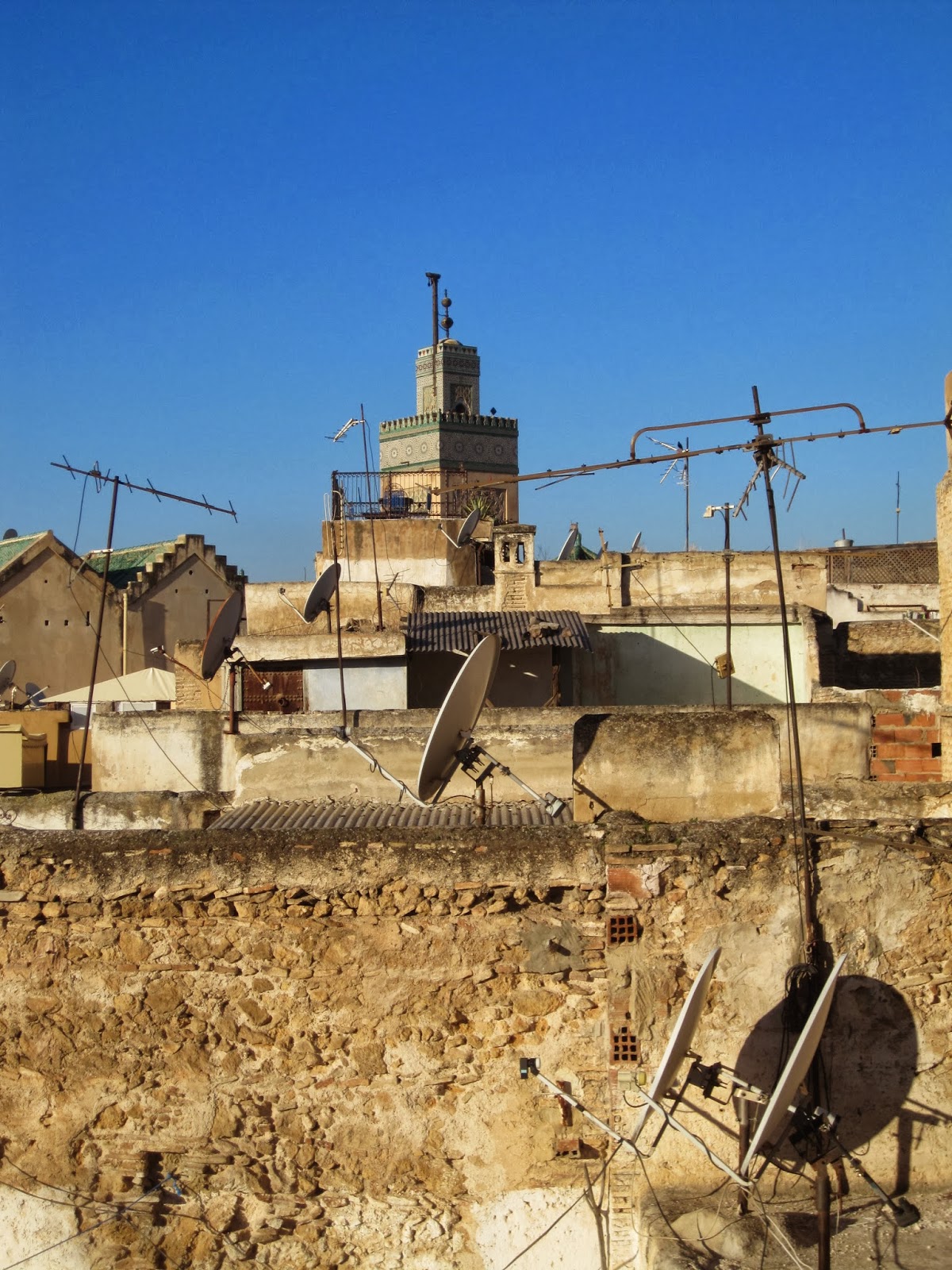
Satellite TV seems to be the big thing in Fes with the roof tops covered. There wasn't one in our riad available for guests but Petal had her Surface which we watched a few shows on before bed in the evening.
Doorway shopping(no windows!) tea taking and chatting in the streets seem to be a big part of life in the Medina.
 |
| A satellite for every home |
 |
| New Year's day party cakes |
I really enjoyed my visit here and would love to go again to see the ceramic works and the mosaic craftsmen at work. All the bustle and hustle was quite overwhelming and we felt that three nights was quite enough in one hit. Summertime would be a bad idea I think.
 |
| Dentist advertising - he prefers to pull! |
 |
| The local fountain for our riad |
 |
Desert everywhere was 'seasonal fruits'
which was mandarins |
 |
About £23 for a three course meal for four
The leather guide's mum was the cook and made the best
Couscous I've ever had, hot, fluffy, savoury.
I wish I had enough courage to have asked for a lesson! |
 |
| First black tea - Casablanca Maccas |
 |
| Tea bag hat?! |
 |
| Moroccan colours in the Mosaics |
 |
UNESCO has listed the Fes Medina as a cultural
World Heritage site. Financial help is coming from
Italy and the US to renovate and preserve. Foreigners
are encouraged to buy dilapidated Riads, fix them up
and run them as tourist guest houses. |
 |
| Most mirrors have shutters over them - perhaps to discourage vanity |
 |
| Silver pots for sale - approx 1200Dh for a mid sized one |
 |
| Woven bags in the souk |
 |
Beautiful brass lamps - all electric,
we wanted an egg shaped candle one |
 |
A new fruit selling from a barrow
the round beetroot coloured flesh stained
the lips, we forgot to eat ours for breakfast
and didn't think they'd go down too well in the train! |