The tide to Portsmouth Harbour is fast and deep. The channel is filled with lighted beacons and buoys to guide the countless ferries, merchant vessels and naval craft past the sand bars, through its narrow passage and into the calm safety of protected waters.
The choppy tides have chronicled the arrivals of invaders from the cold north and the French who come to burn the farms and villages taking valuables in both goods and souls. They have propelled returning victors from naval battles to celebration and recuperation. They have carried in the plague and treasures from other lands; not caring or even knowing of their cargo but forever obeying the natural laws that man has long sought to subdue.
 |
| Arial view of the narrow mouth from http://www.capitalonechauffeurs.co.uk/images/Portsmouth-Port.jpg |
Yet the pull of those relentless waters gush both in and out. Portsmouth has been the sight of so many farewells, where the tears of those remaining and those leaving have added to the salt of the Solent.
From the time Alfred the Great fitted out England's first ever navy in 897, Portsmouth has been a harbour of nationalistic endeavour. This first navy chased off the Danes and brought peace and prosperity to the fledgling kingdom. Its position faces the coast of France across the English Channel, protected from the worst of southerly gales by the Isle of White. Hugging the coast through the Strait of Dover, those early ships of Alfred's own design, legend has it, braved the North Sea and drove back the Norsemen coming to reassert their hold on the British Isles.
 |
Mary Rose Now
After 20 years of damping down with water, glycol and wax it is now slowly being dried out - 4 yrs to dry! |
 |
Skeleton of a ratter found trapped
in the surgeon's cabin on the Mary
Rose. Looks a bit like Charlie. |
King Henry V took a flotilla of 1500 boats and ships from Portsmouth to fight the battle of Agincourt. Henry VII built the first dry dock at Portsmouth and Henry VIII built the first Naval dock in Britain there. He named one of his many new ships after his sister the French Queen, Mary Rose. She served against the French and Spanish navies for thirty years. In a battle against French forces at the mouth of Portsmouth Harbour, Henry VIII watched her sink from Southsea castle and heard the horror of the farewell cries coming from the sailors across the water. After firing a volley from her lower deck cannons, a swell lent her over and the open hatches invited the whirling currents into her depths. Between 400-700 men were trapped below the rigging designed for hand to hand combat with enemy ships, only 35, manning the upper masts and castle decks, escaped the watery grave.
 |
| Henry VIII's Southsea Castle from where he heard the wails of the drowning sailors. |
Henry's unsuccessful attempts to increase or even maintain his holdings in France depleted the treasury so that by the time his third child took the throne there was little left to continue his naval pride. Yet now Britain faced the biggest naval threat of her history. Elizabeth was a wiley ruler and had encouraged her daring sailors to seek fortune and fame across the Atlantic. Felipe II accused her subjects of piracy as they attacked the Spanish treasure ships and sought the Heretic Queen's support to stop the devastation at sea. Elizabeth and her advisers stroked with the left hand and continued beckoning the loot into the country's treasury with the right. Francis Drake had sailed the Golden Hind around the world and on the way home attacked Cadiz on the Spanish mainland and looted Lisbon, newly 'acquired' by Felipe. Elizabeth knighted him on his ship in the year before his skills would be pressed into protecting the realm.
 |
SPAENSCHE ARMAD INT IAR 1588 W/He sold at auction for £138 650
Dutch school 1604-09
Under the leadership of the Earl of Leicester (suggested to be the figure in red holding the flag of St George) the British were helping the Dutch rid their territories of the Spainards. This is possibly the coast north of Calais where the British fleet chased the Armada into the North Sea. |
Portsmouth was
not used to amass the navy - it was split between the Downs in Kent and Plymouth in Devon yet plenty of men took sloops from Portsmouth to meet the English fleet heading out to the channel once the Spanish had been sighted. The southern coast was lined with warning beacons and standing soldiers waiting for the threat of invasion to be fulfilled. Imagine the cheering and nationalistic flag waving as the English ships converged off the coast going to protect them from the great fear of the protestant country - the inquisition. The nervous energy as pride and fear swiveled through waves of hope and dashes of pessimism would have fueled mighty weapons if only it could be captured and channeled. After the battle off the coast of Calais the wind forced the Spanish to head up and into the North Sea and home the long way, struggling to stay afloat. The southern coast was no longer threatened and their ships left the Armada to the elements.
If the Spanish had landed at Portsmouth and unleashed the army and canon they carried instead of following orders to await reinforcements from the Netherlands (who had no way of passing their Dutch enemy as Felipe expected them too) all of the 11 000 Spanish sailors and soldiers who succumbed to starvation, drowning, slaughter and shipwreck may not have perished. Many of those that reached home died within months from exhaustion and disease.
 |
| http://www.ibiblio.org/hyperwar/NHC/reestablishment/reestablishment.htm |
Now that Britannia ruled the waves and the age of Empire had begun, boating activity around the south coast was continuous. Portsmouth had a seedy side where Kings coins were dropped into tankards and the drinkers discovered that upon finishing the pint they had been paid in advance for 2yrs of service in the Royal Navy. Press gangs guided them through tunnels below the pubs and brothels to waiting ships where they worked or died. These extensive tunnel networks are still causing problems for developers in the modern day town. These men were never given a chance to farewell their lives and many never returned.
 |
| First Fleet to Australia leaving Portsmouth - source:http://surlingham.org/susannah-holmes/ |
 |
This link sculpture has a twin near
Lady Maquarie's chair in the
Sydney Botanical Gardens |
An even sadder scene was enacted at Portsmouth in the 1700s. Chains instead of bunting, whips instead of streamers and cramped conditions fouled by a single bucket for scores of prisoners instead of deck views filled our heads as we stood where the First Fleet of prisoners bound for the penal colony of New South Wales last touched English soil. In 1788 the British government sent 6 ships full of convicts of to Australia under the guard of three naval ships and the leadership of Captain Arthur Philips; 60yrs before the First four ships to Canterbury - NZ - left from Plymouth down the coast.
English prisons were overflowing, many were kept in rotting ship hulls and died of dysentery, typhoid or gangrene from rat wounds long before their sentences were completed. The American War of Independence resulted in California's refusal to take any more of England's damned. The British justice system at the time meted out jail terms for things like for stealing bread by fathers of starving families. The poor were considered to be deserving of their fate and their petty crimes merely proof of their lack of moral development. There were many poor people sentenced to transportation for trying to survive.
As we stood on the shore of Portsmouth, we couldn't help but imagine the anger, frustration and hopelessness of those leaving to serve their sentences in the NSW penal colony. Many of the prisoners finished their sentence terms during the journey but they were never able to return home. Only three supply ships accompanied the first fleet - all the women's clothing was left behind and the tools intended for turning trees into townships were of poor quality and couldn't cope with the enormous hardwoods growing at their destination. Those that survived the lack of supplies and starvation that the first two years of life near Sydney Cove offered to Marine and Convict alike, gave birth to a nation that is still known for its resilience and endurance.
The year after the Australian first fleet left Portsmouth Marie Antoinette and Louis XVI were beheaded in the violent French revolution. British Law and order were threatened by these events and clamped down even harder on the lower classes seeking emancipation. The Magna Carter had relieved the Monarch of totalitarian rule so the argument that all people had a voice through their MP and had no need to revolt kept the outspoken to a minority. People proudly stepped forward in the following years to join the royal navy in order to protect England from Napoleon's ambitions. One of M's favourite TV shows, The Hornblower Series filmed many of its port scenes at Portsmouth.
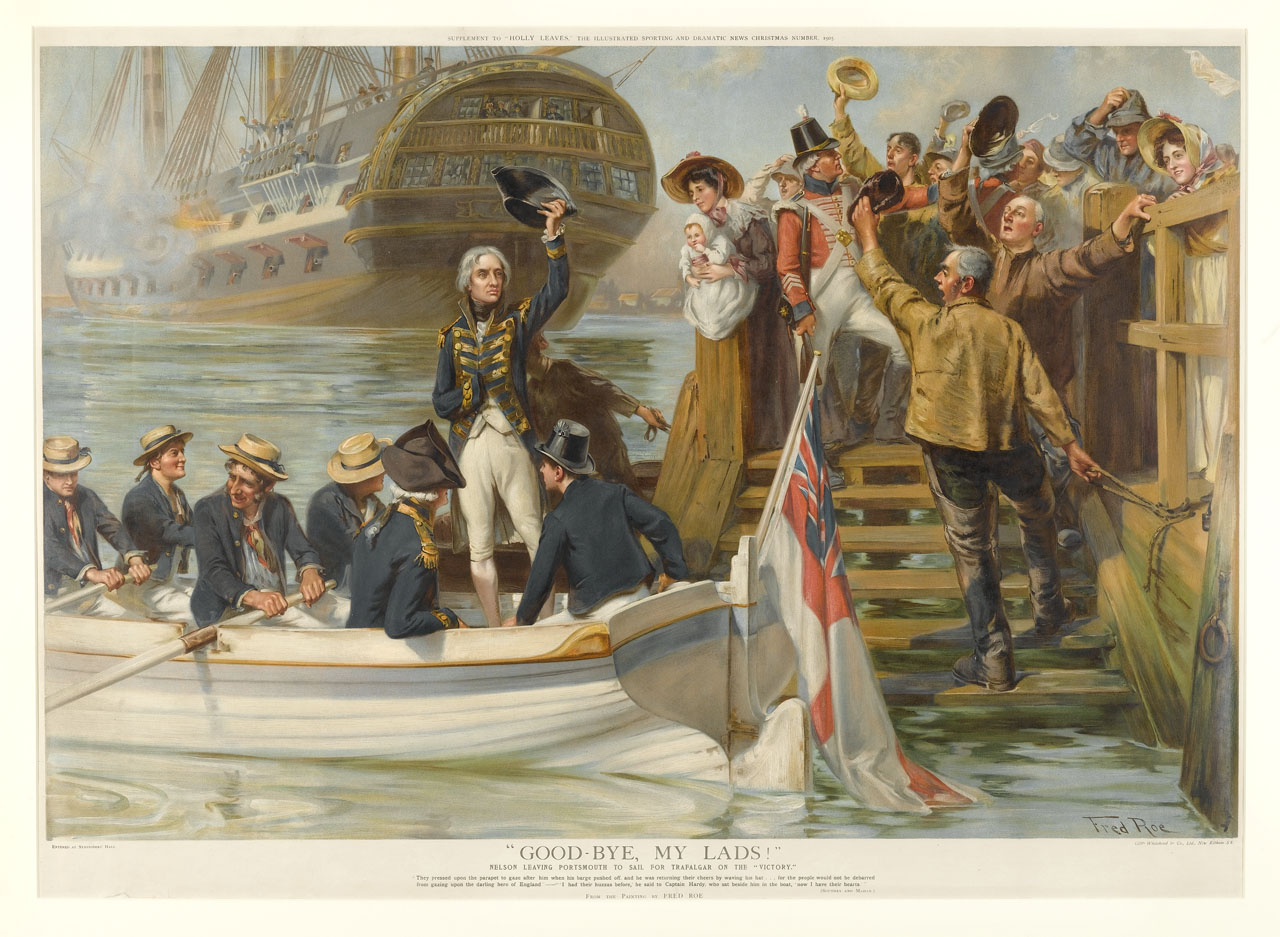
Admiral Nelson left Portsmouth to lead the British navy against the combined Spanish and French fleets. The British were victorious but Nelson did not survive the expedition. His last views of his homeland were of the Portsmouth coast.
 |
| In remembrance of Lord Admiral Nelson |
 |
| Nelsons last public words at Portsmouth |
 |
HMS Victory - Still called 'The World's Greatest Warship' for all the battles won from the war of American Independence
until 1808-1812 battles in the Baltic. It was dry docked in 1922 for preservation after serving as the flagship of various naval commanders in Portsmouth. Nelson perished on her in 1805. |
 |
| Gun deck on the Victory. Sand buckets to put out fires. |
 |
| Bunks were swung wherever there was room. The dead were sewn into their hammock for burial at sea with the last stitch passing through their nose just to make sure the sailor was dead. The lanterns were a continual fire hazard. |
 |
| Friendly loos, a bit rough in stormy weather! |
 |
The battle raged onto Victory following the
dead Admiral's commands |
 |
| A statue to Scott at the Portsmouth Historic Dockyard. |
Another who said farewell England from Portsmouth never to return was Robert Scott. His team was a combination of scientists and explorers. Scott was beaten to the South Pole by Norwegian - Roald Amundsen and never made it back to the coast, perishing within 11 miles of the food dumped ready for his return.
Still more people left their homeland for the last time from Portsmouth but under such strictly secretive conditions that those leaving looked behind to see no one waving them off as they headed towards Normandy. A ten mile wide coastal strip had been cordoned off and troops were camped under the cover of forests north and east of Portsmouth. As I stood looking towards man made islands, one of which is now a very expensive hotel, I tried to envisage the description given in the D-Day museum notes that there were so many ships it was almost possible to walk from Portsmouth to the Isle of White across their decks. An island in the harbour had been used to practice 'landing on the beaches' ready for Eisenhower's "OK we'll go" on the 5th of June 1944.
 |
| Dad's army gear at the gift shop |
On the 6th of June 1944 over 150 000 troops left the south coast of England in nearly 7000 vessels to plunge through a 10 mile wedge of mine cleared stormy waters towards the beaches of Normandy. All of them had said their farewells long before leaving Portsmouth. Thousands of allied forces repelled from their European homes joined the British, Canadian and American troops. Under complete communication block out to protect the essential element of surprise, none of the naval crews, army, parachutists or air force personnel had been able to write to their loved ones of the coming conflict. Even though the false intelligence leaked to German forces kept the enemy light around the real landing sites, new research from the US National D'Day Memorial Foundation have found that over 4000 men died that day.
 |
Amphibious landing craft on the coast of Normandy - the beach names were coded.
image from: http://www.history.navy.mil/photos/events/wwii-eur/normandy/normandy.htm as we obviously weren't there! |
The last large collection of ships to farewell their homeland leaving from Portsmouth was in 1982. On the 5th of April a task force of naval ships left to travel over 7000 miles to protect the British governed Falkland Islands against Argentinian claims. 900 troops had seen their homes for the last time. 6 British ships were sunk in the cold South Atlantic.
 |
This emotional photo of the Faulkland task force farewell was used in the 2010 report by the Daily Mail in 2010 in an article about the decommissioning of the Harrier carriers.
|
 |
The hovercraft seemed to be tossed around by the tide
and looked like it wasn't going to make it through the
narrow mouth of the harbour - it didn't, see next. |
Since this time the comings and goings from Portsmouth Harbour are those catching the overnight Brittany Ferry for holidays or business with few leaving home never to return. The £10 return trip on the Hovercraft to the Isle of White is a daily or weekly commute for many who leave their homes for work in London or closer towns.
 |
Watching the hover craft drive up onto the beach
from Mozerella Joe's - a good cream tea! |
Our visit to Portsmouth summoned all these shadows through the Museums and monuments that line the seafront to honour them. But peace has bought development and the Spinnaker tower and Gunwharf Quay Outlet mall with plenty of restaurants and cinemas are just as engaging. The Whittard, Crabtree and Evelyn, Osprey London, White stuff and Lindt (at last the raspberry syrup block is found) stores were my favourite with lots of stock at super discounted prices. The girls preferred Jack Wills, Cadbury for Mishapes bags, Fossil, Quba & Co and The Body Shop for their bargains. The Nero Café let Charlie sit inside and Carluccios, with wonderful harbour views, had heaters under their outdoor umbrellas and gave him a bowl of water.
 |
We stood up close as it readied for its next crossing.
It spun around 180 to great whirrings and wheezings,
then once facing the sea took off towards the Isle of White. |
 |
| Charlie shopping in his dapper jumper |
Forever Farewells are more likely to be witnessed at airports than seaports in our times. The saddest are far away from this green land, where insane political and religious jealousies are ripping families and economies apart. These countries are bleeding out those that long to call them home but to maintain life, are forced to leave.
 |
Our Hotel - South Parade
£6 taxi fare from the Quay |
 |
a bar and bistro - great shepherds pie, broccoli and
blue cheese soup and Bearnaise sauce on the steak.
Really good lemon posset too. |
 |
Keeping a close eye on those tricksy waves
Stones put over the golden sand to slow erosion. |
 |
I don't care how many times you throw the stone
in the water I am not going to fetch! |
 |
| Waiting for the tide to come in? |
 |
| Excellent splicing on the 'Warrior' |
 |
| Gunwharf Quay shops and Restaurants from Carluccios |
 |
Gav's friend lives here. What a place, great views, it got a bit wet in recent storms but no damage done.
The Spinnaker Tower in behind is a viewing deck - with a glass floor! |
Novels that recreate the First Fleet's experience once landed at Sydney Cove.
The Trilogy of books by
Kate Grenville - http://kategrenville.com/biography.
In chronological order of experience (not publishing) - Each book is a stand alone story but reading all o f them certainly fills in the gaps for a Kiwi Aussie like me who studied Aotearoa's history as a kid but had to teach first contact history in NSW schools. The times really come alive in these novels.
2008 "
The Lieutenant was inspired by a real story that took place in the colony of New South Wales in the last years of the eighteenth century. The story has been hidden for two hundred years between the lines of two shabby blue notebooks stored in a London manuscript library. They record the extraordinary friendship between Lieutenant William Dawes, a soldier with the First Fleet to New South Wales, and a young Aboriginal girl, Patyegarang.
Dawes - a scholar more than a soldier - set out to learn the language of the people of Sydney Cove, the Gadigal. The notebooks begin with lists of nouns and verbs and grammatical forms, but gradually abandon that approach for a more human one: Dawes recorded entire conversations that took place between him and Patyagarang. Between the lines of the converstations it's clear that they developed a relationship that was mutually respectful, playful, and warmly affectionate. It was almost certainly not a sexual relationship, but one of those friendships that can arise between a clever young person and an adult."

2005 The Secret River "William Thornhill, an illiterate Thames bargeman and a man of quick temper but deep feelings, steals a load of timber and is transported to New South Wales in 1806. Like many of the convicts, he's pardoned within a few years and settles on the banks of the Hawkesbury River. Perhaps the Governor grants him the land or perhaps he just takes it - the Hawkesbury is at the extreme edge of settlement at that time and normal rules don't apply.
There's just one problem with that land: it's already owned. It's been part of the territory of the Darug people for perhaps forty thousand years. They haven't left fences or roads or houses, but they live on that land and use it, just as surely as Thornhill's planning to do."
2011 Sarah Thornhill "Sarah is born in 1816, her father an ex-convict who’s made good in the new colony of Australia. Three hundred acres, a fine stone house, the money rolling in – William Thornhill is a man who’s re-invented himself. As he tells his daughter, he never looks back, and Sarah grows up learning not to ask about the past.
Her stepmother calls her wilful, but handsome Jack Langland loves Sarah and she loves him. Me and Jack, she thinks, what could go wrong?
But there’s a secret in the Thornhill family. It comes out, as secrets will, and draws everything into its tangles. It casts a long chill shadow over life in the Hawkesbury valley.
That secret propels Sarah backwards, into the darkness of her family’s past. And it propels her forwards, into a future very different from the one she’d imagined for herself. She travels across the ocean to the wild coasts of New Zealand, and among the strangers of that other place she sees the way things truly are.
Sarah Thornhill is set in the past, but it’s as much about today as about yesterday. It’s about the dark legacies hidden in families, about love and unlooked-for happiness, and about keeping stories alive."
Reading Now:
Philomena by Martin Sixsmith, PAN books 2009 (First published as The Lost Child of Philomena Lee)
 |
| http://www.amazon.co.uk/Philomena-true-story-mother-tie/dp/1447245229 |
A tale that builds to and continues to regret a heart wrenching goodbye. It highlights the impotence of the Irish government in the 50's in the face of the pressure from the Roman Catholic Church and its Bishop's judgemental intervention in the lives of the women who sinned and became pregnant out of wedlock. This permitted the economic and psychological abuse the convents chose to wield.
From the moment 3yr old Anthony Lee is taken with the forced permission of his young and guilt driven mother, from the convent where he had been treated kindly by the nuns and loved by his mum every evening after her labour filled day we loose sight of Philomena altogether. She becomes a fleeting ghost in the memory of her son as we follow his path through life. He is a high achiever but never looses the sense that he must have been very bad for his mum not to want him. In the book although Mike(Anthony's new name) searches for his mum he dies before ever meeting her. He wills his remains to be buried in the convent graveyard so that if his mother should ever try to find him he would be waiting for her.
Anthony's whole life is built on the torment of not belonging. Because Philomena is so distressed after seeing her son and a friend's daughter taken for adoption to US parents they release her from the three year contract in the convent laundry to pay back the expense of the 'charity' extended to her. She is sent to England never allowed to show her 'sinful' face in her home town and forbidden by the Church to reveal any matters of her experiences to anybody under threat of eternal damnation. Two marriages and a couple of kids later she finally spills the beans of her sad story one Christmas eve and the detective - plot driver - is approached.
I haven't seen the film but the cover of the book has a scene from it where mother and son are sitting together - I can only surmise that the ending has been changed.
"Philomena fell silent - she had spent her life doing what the nuns told her to do and a lifetime of submission is not easy to overcome." p51
"In the three and a half years since her arrival at Sean Ross Abbey Philomena had had no contact with her family. Neither her father nor her brothers and sisters had visited her and the nuns would not pass on any letters." p81
"So what I think is this: they gave us away because they saw we were very bad inside, and that's why they never loved us. And now no one can ever love us because of what we are." p120
 In 'The Art of Travel', the author, Alain de Botton points out that his disappointment in his long awaited tropical get away was mainly due to the fact "that I had inadvertently brought myself with me to the Island." He completely bought into the poster image of the white sand, waving palms and blue arc of the bay and expected some miracle to occur that would transform him into half of the happy, carefree couple strolling down the beach. Well miracles do happen but I think in this instance a bit of Cognitive therapy would be more effective.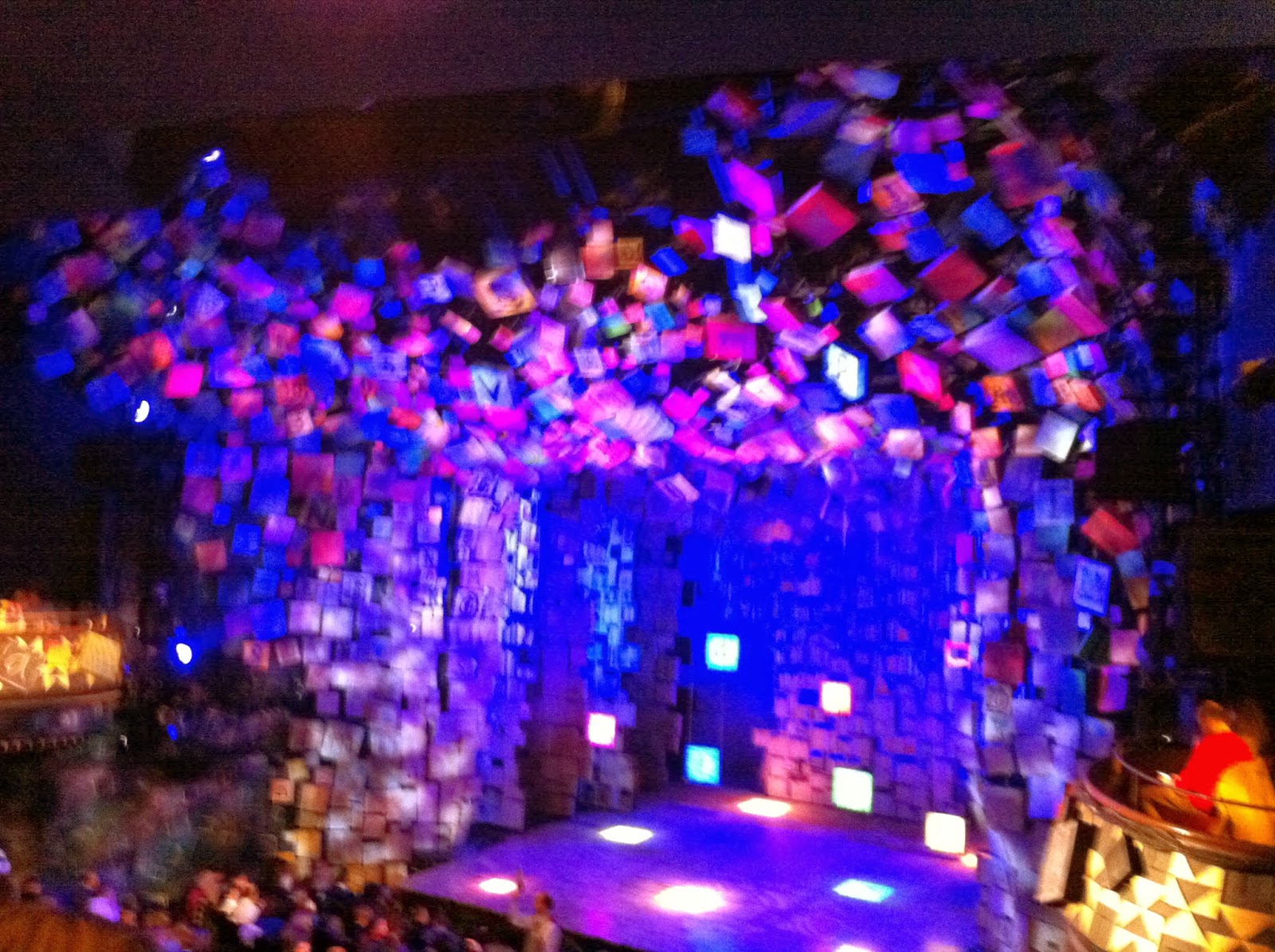
 Mr Kelly says in the programme that 'watching someone writing a book on stage would be about as interesting as eating sprouts.' (The English seem to have a love hate relationship with this wee cabbage.) The change he made from Matilda's love of reading being extended to a love of story telling added dimension and empowered the original themes of the novel.




 By the end of High school Paul Klee was professional standard violinist but chose to move away from Switzerland to Munich in order to free himself from his musical parent's expectations. After a tour in Italy he got a bit overwhelmed and depressed because he felt everything brilliant had been done and he knew his drawing skills were not comparable to the renaissance men. His love for composition and colour and his philosophical attitude towards life soon etched out a cubby for his place in the art world though and he experienced fame and fortune within his lifetime. He was a little bit abstract (friends with Kandinsky) a little bit cubist and a little surreal. He numbered his works from the first through to the last so art historians love him. Close artist friends died fighting in WW1. He escaped by being given the task of painting numbers and symbols on the planes of Germany's first air force. In WWII Hitler denounced him as a degenerative artist so he fled to Switzerland with his wife and son.
  "Anticipatory and artistic imaginations omit and compress, they cut away the periods of boredom and direct our attention to critical moments and, without either lying or embellishing, thus lend to life a vividness and a coherence that it may lack in the distracting wooliness of the present." p15